
Why Lord Shiva Is Worshipped for Marriage Blessings. Understand The Astrology Behind It.
Across India, in temples and home shrines alike, unmarried women and men have for centuries turned to one deity above all when they long for a loving, lasting marriage: Lord Shiva. Girls observe the Solah Somvar (sixteen Mondays) fast praying for a husband like Shiva. Married women keep Teej for the wellbeing of their spouse. The Shiva-Parvati union is invoked at almost every Hindu wedding. But why Shiva — the ascetic, the meditator, the god who sits in cremation grounds smeared in ash? Why is the most detached deity in the pantheon the one people pray to for the most intimate of bonds?
The answer lies in astrology, mythology, and a profound spiritual truth about what marriage really is. In this guide we will explore why Lord Shiva is worshipped for marriage blessings, the astrological logic behind it, the story of Parvati's tapasya that made her worthy of him, and the traditional practices — including the 41-day Parvati sadhana — that devotees observe when preparing for marriage.
Lord Shiva is worshipped for marriage because the Shiva-Parvati union represents the ideal of a marriage rooted in devotion, patience, and mutual completion. Astrologically, Shiva governs Saturn (time, discipline) and the deeper transformation that committed partnership requires — which is why his blessing is sought for both finding and sustaining a spouse.
The Deity of Transformation and Time
To understand Shiva's connection to marriage, you first have to understand what Shiva governs. In Vedic thought, Shiva is the lord of transformation — the destroyer not in a negative sense, but as the force that dissolves the old to make room for the new. He rules over time itself (Mahakala), over discipline, over the inner death of the ego that any deep relationship demands.
Marriage, understood spiritually, is exactly this kind of transformation. Two separate lives dissolve into one shared life. The self-centred "I" must soften into "we." This is not easy — it is, in a sense, a small death of the ego and a rebirth into partnership. No deity presides over that kind of sacred transformation more completely than Shiva.
Shiva and Saturn: the astrology of commitment
Astrologically, Shiva is closely associated with Saturn (Shani) — the planet of time, patience, responsibility, and endurance. Saturn is often the very planet that delays marriage, testing the native's readiness and maturity. By worshipping Shiva, who governs Saturn's domain of discipline and time, devotees seek not to escape Saturn's lessons but to move through them with grace.
This is a crucial reframe. People sometimes worship Shiva hoping to "remove" a delay. But the tradition understands it differently: Shiva's blessing helps you become ready for marriage — patient, grounded, mature — so that when the union comes, it can endure.
The blessing of Shiva begins with the devotion of Parvati
The Swayamvar Parvati Yantra honours Mata Parvati, whose tapasya won Shiva's heart. It is made for those preparing for marriage who wish to walk the same path of devotion.
Explore the Yantra →The Ideal of the Shiva-Parvati Marriage
When a young woman prays for "a husband like Shiva," she is not asking for an ash-smeared ascetic. She is invoking an archetype — a partner who is faithful, unshakeable, spiritually deep, and utterly devoted once committed. And when devotees invoke Shiva-Parvati together, they are invoking the model of an ideal marriage itself.
What makes their union the eternal template?
- Equality — Shiva and Parvati are depicted as Ardhanarishvara, half-male and half-female in one body. Neither is complete without the other. This is partnership as genuine equality, not hierarchy.
- Devotion tested by time — Parvati did not win Shiva easily. She undertook years of tapasya. Their love was earned through patience and sincerity.
- Mutual transformation — Parvati draws Shiva from isolation into householder life; Shiva draws Parvati into the deepest spiritual wisdom. Each elevates the other.
- Endurance — theirs is a love that survives separation, hardship, and cosmic upheaval. It is built to last.
Parvati's Tapasya: the Original Preparation for Marriage
The heart of why Shiva is worshipped for marriage is the story of how Parvati won him. Shiva, deep in meditation and detached from the world after the loss of Sati, had no interest in marriage. Parvati — Sati reborn — resolved to win him not through beauty or persuasion, but through devotion and self-discipline.
She left the comforts of her palace and undertook severe tapasya. She meditated through heat and cold, ate less and less, and turned her entire being toward Shiva with unwavering focus. Sages doubted her. Even Shiva, testing her in disguise, tried to dissuade her. She proved everyone wrong. Her devotion was so complete that Shiva finally recognised her as his equal and his eternal companion.
Parvati's story reframes the entire idea of "waiting" for marriage. She did not wait passively — she prepared. She became worthy of the partnership she desired through devotion and discipline. This is the spiritual logic behind every marriage sadhana.
Why This Matters for You Today
If you are experiencing a delay in marriage, or feel that the right partnership keeps slipping away, the Shiva-Parvati tradition offers something more useful than anxiety. It offers a framework: prepare, don't just wait.
Preparation, in this tradition, has two dimensions. The outer dimension is devotional practice — fasting, mantra, and sadhana. The inner dimension is character — cultivating the patience, faith, and steadiness that a Shiva-like partnership requires. The two work together. The practice shapes the character; the character makes you ready for the union.
The practices devotees observe
- Monday worship (Somvar) — Monday is Shiva's day. Offering water and bilva leaves to a Shivling, especially the sixteen-Monday Solah Somvar vrat, is a classic marriage practice.
- Maha Shivratri — the great night of Shiva, observed with fasting and night vigil, is considered especially powerful for those seeking a spouse.
- The Parvati sadhana — for those seeking marriage, a 41-day devotional practice dedicated to Mata Parvati / Katyayani, following the archetype Parvati herself set.
- Chanting the Katyayani mantra — the mantra traditionally associated with prayers for a good husband.
Walk Parvati's path with a 41-day sadhana
The Swayamvar Parvati Yantra anchors a traditional 41-day practice dedicated to Mata Parvati. It is made to support those preparing for a marriage rooted in devotion — following the very archetype Parvati set.
Begin your sadhana →The Katyayani Connection
Among all the forms of the goddess, Katyayani holds a special place for those seeking marriage. In the Bhagavata Purana, the unmarried gopis of Vrindavan worshipped Goddess Katyayani, praying for Krishna as their husband. This established Katyayani as the form of the Divine Mother whom the unmarried worship for a loving spouse.
Katyayani is a fierce, radiant form of Parvati. To worship her is to invoke both the tenderness of the mother and the strength of the warrior — the full spectrum of qualities a person needs to attract and sustain a strong marriage. This is why a Parvati-Katyayani sadhana sits at the heart of the marriage-blessing tradition.
A Word on Sincerity vs. Superstition-Style Thinking
It is worth being clear-eyed. These practices are not magic switches. Lighting a lamp or chanting a mantra does not compel the universe to deliver a spouse by a deadline. That is not how devotion works, and treating it that way misses the entire point.
The tradition asks for something deeper: sincerity, patience, and inner preparation. The practices are believed to support marital harmony and to help align the practitioner with the energies of committed partnership. Their real power is in what they do to you — the discipline they build, the faith they strengthen, the readiness they cultivate. Approached this way, worshipping Shiva-Parvati for marriage is not about outsourcing your destiny; it is about becoming the kind of person a great partnership can be built with.
Shiva is worshipped for marriage not because he removes obstacles by force, but because his union with Parvati is the eternal model of a marriage earned through devotion, matured through time, and sustained through mutual completion.
Frequently Asked Questions
Why is Lord Shiva worshipped for marriage?
Lord Shiva is worshipped for marriage because his union with Parvati represents the ideal of a devoted, enduring, and equal partnership. Astrologically, Shiva governs the domain of Saturn — time, patience, and the maturity that committed marriage requires. Devotees seek his blessing to become ready for a lasting union rather than to force an outcome.
Which day should I worship Shiva for marriage?
Monday (Somvar) is traditionally Shiva's day. The sixteen-Monday Solah Somvar vrat and Maha Shivratri are especially associated with prayers for marriage. For a goddess-centred practice, a continuous 41-day Parvati sadhana is commonly observed.
What is the significance of the Shiva-Parvati marriage?
The Shiva-Parvati marriage is considered the archetype of an ideal union — built on equality (Ardhanarishvara), devotion earned through Parvati's tapasya, mutual transformation, and enduring commitment. It is invoked at Hindu weddings as the model of a blessed, lasting marriage.
Who is Katyayani and why is she worshipped for marriage?
Katyayani is a fierce, radiant form of Parvati. In the Bhagavata Purana, the unmarried gopis worshipped her praying for Krishna as their husband, establishing her as the goddess whom the unmarried worship for a loving spouse. A Parvati-Katyayani sadhana sits at the heart of the marriage-blessing tradition.
Does worshipping Shiva guarantee marriage?
No genuine tradition guarantees a specific outcome. Worshipping Shiva-Parvati is believed to support marital harmony and to help the devotee cultivate the patience and readiness that lasting partnership requires. Its purpose is inner preparation and devotion, not a promise of results by a deadline.
The next time you see a woman offering water to a Shivling on a Monday, or hear of a 41-day Parvati sadhana, understand what is really happening. It is not a plea to a distant god. It is the same act Parvati herself undertook — the sincere, disciplined preparation of a heart that is ready for a great and lasting love.
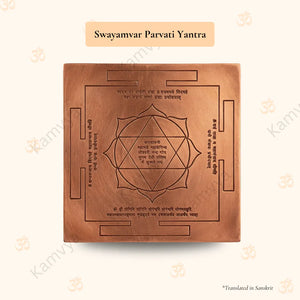
Swayamvar Parvati Yantra
A laser-engraved copper yantra rooted in Parvati Tantra, made for those preparing for marriage — designed to support Shukra (Venus) activation and strengthen the 7th house of partnership over a 41-day sadhana.
Explore the Yantra →