
World's First Love Marriage: Lord Shiva and Parvati
In an age when love marriage still sparks family debates across India, it is worth remembering something remarkable: the very first love marriage in our tradition was between two gods. Long before the concept was named or argued over, Parvati chose Shiva — not because families arranged it, not because horoscopes were matched by elders, but because her heart chose him and her devotion won him. The marriage of Shiva and Parvati is, in the truest sense, the world's first love marriage.
This matters more than it might seem. In a culture where "love marriage" is sometimes framed as modern, rebellious, or against tradition, the Shiva-Parvati story reveals the opposite truth: self-chosen, devotion-driven union is woven into the very fabric of our oldest sacred stories. In this guide, we will explore why Shiva and Parvati's marriage is considered the archetypal love marriage, what made it a self-chosen union, and what it teaches those pursuing love marriages today.
The marriage of Shiva and Parvati is considered the world's first love marriage — a self-chosen union driven by Parvati's own choice and devotion rather than family arrangement. It establishes love marriage not as a modern rebellion but as a sacred, tradition-honoured path when built on genuine devotion and commitment.
What Makes It a "Love Marriage"?
In the classical sense, a love marriage is one chosen by the individuals themselves, born of mutual attraction and personal decision rather than family arrangement. By this definition, the Shiva-Parvati union qualifies completely — and dramatically.
Consider the facts of their story. Parvati chose Shiva entirely on her own initiative. Her family, particularly, had every reason to hesitate — Shiva was an unconventional groom by any measure: an ascetic who lived in cremation grounds, wore ash and serpents, kept the company of ghosts, and had no interest in worldly wealth or status. He was not the match a mountain king would arrange for his daughter.
Yet Parvati was resolute. She did not wait for an arrangement. She did not settle for a "suitable" match. She set her heart on the one she loved and pursued that love through the most demanding path imaginable. This is self-chosen union in its purest form.
The unconventional groom
What is striking is how much Shiva resembled the kind of "unsuitable" match that families still resist today. He came from a completely different world than Parvati's royal upbringing. He had no conventional credentials. By every worldly measure, elders would have counselled against him. And yet the marriage became the most celebrated union in all of sacred history. The lesson for those facing family resistance to their own chosen partner is profound.
Honour the goddess who chose her own love
The Swayamvar Parvati Yantra draws its name from Parvati's self-chosen union. It is made for those preparing for marriage — including those pursuing a love of their own choosing — through a 41-day devotional sadhana.
Explore the Yantra →The Meaning of "Swayamvar"
The word swayamvar itself illuminates this theme. Derived from Sanskrit, it means "self-choice" — swayam (self) and vara (choosing/groom). In ancient tradition, a swayamvar was a ceremony where a woman chose her own husband from assembled suitors. It was a formal, honoured institution of self-chosen marriage embedded in our oldest texts.
Parvati's union with Shiva is a swayamvar in the deepest spiritual sense. She chose him — not from a lineup of suitors, but through the sovereign act of her own devoted heart. The concept of a woman choosing her own life partner, far from being foreign to tradition, is enshrined in the very word and in the very stories we hold most sacred.
Devotion as the Foundation of Chosen Love
Here is where the Shiva-Parvati love marriage offers its most important teaching. A self-chosen union is not built on impulse or infatuation alone. Parvati's choice was validated and made unshakeable by devotion — years of tapasya, of proving her love's depth, of transforming herself to be worthy of the partnership she desired.
This is the crucial distinction the story draws. Love marriage in the Vedic vision is not the opposite of a sacred, considered union — it is a sacred, considered union that happens to be self-chosen. Parvati's love was:
- Chosen — she decided, of her own free will.
- Devoted — she proved her commitment through tapasya.
- Enduring — she pursued it through every obstacle.
- Discerning — she knew exactly whom she loved and why.
A love marriage built on these four pillars carries the same dignity and blessing as any union — arguably more, because it is chosen with full heart and proven through devotion.
Love marriage is not a departure from tradition. The world's first and most celebrated marriage was self-chosen and devotion-driven. What tradition asks is not that you avoid choosing your own love, but that you bring devotion, discernment, and commitment to whatever love you choose.
Lessons for Love Marriages Today
Millions of people today pursue love marriages, often against significant family resistance. The Shiva-Parvati story offers real guidance for this path.
Resistance is not a verdict
Parvati faced doubt from sages and the unconventional nature of her chosen partner. Family or social resistance to a love marriage does not mean the love is wrong. Sometimes it is simply the testing ground on which a strong union is forged. What matters is the depth and sincerity of the bond.
Devotion strengthens the union
Parvati did not merely fight for her love — she deepened it through devotion. Those pursuing love marriages can draw on the same source: a devotional practice that steadies the heart, invites grace into a tense family situation, and strengthens the bond itself. This is not about forcing anyone's acceptance; it is about grounding your own union in something sacred.
Choose with discernment, not just desire
Parvati's choice was clear-eyed, not blind. A love marriage worth pursuing is one chosen with genuine understanding of the partner — their character, values, and compatibility — not merely the intensity of attraction. Rahu-driven infatuation and true love can feel similar in the moment; the story reminds us to choose with the discernment Parvati showed.
Ground your chosen union in devotion
For those pursuing a love of their own choosing, a 41-day Parvati sadhana offers steadiness and grace. The Swayamvar Parvati Yantra follows the path Parvati herself walked toward her self-chosen union.
Begin your sadhana →The Enduring Relevance of the First Love Marriage
When we call the Shiva-Parvati union the world's first love marriage, we are not diminishing it to a modern category. We are recognising that the values a good love marriage requires — free choice, deep devotion, discernment, and enduring commitment — were perfectly embodied in this sacred union at the dawn of our tradition.
For anyone whose heart has chosen its own path in love, this is a source of strength and legitimacy. You are not breaking with tradition. You are walking in the footsteps of the goddess herself, who chose her beloved and won him through devotion. The path may hold obstacles, as Parvati's did. But the tradition offers not just permission but a model — and a devotional practice to walk it with grace.
The world's first love marriage was self-chosen, devotion-driven, and eternal. It reminds every heart that has chosen its own love: this path is ancient, honoured, and sacred — when you bring to it the devotion Parvati brought to hers.
Frequently Asked Questions
Was the marriage of Shiva and Parvati a love marriage?
Yes. The marriage of Shiva and Parvati is considered the world's first love marriage because Parvati chose Shiva entirely of her own will and won him through her devotion, rather than through family arrangement. It is a self-chosen, devotion-driven union — the archetype of love marriage.
What does the word swayamvar mean?
Swayamvar comes from Sanskrit — swayam (self) and vara (choosing or groom) — meaning "self-choice." In ancient tradition, it was a ceremony where a woman chose her own husband. The concept of self-chosen marriage is enshrined in the very word and in our oldest sacred stories.
Is love marriage against Hindu tradition?
No. The Shiva-Parvati story shows that self-chosen, devotion-driven union is woven into the fabric of the oldest sacred stories. Love marriage is not a departure from tradition but a form of union that, when built on devotion, discernment, and commitment, carries the same dignity as any marriage.
What does Shiva and Parvati's marriage teach about family opposition?
Shiva was an unconventional groom whom elders would likely have resisted, yet the union became the most celebrated in sacred history. The lesson is that resistance to a love marriage is not a verdict on the love itself — sometimes it is the testing ground on which a strong union is forged. Depth and sincerity of the bond matter most.
How can devotion help a love marriage?
Devotion, as Parvati showed, steadies the heart, invites grace into tense situations, and strengthens the bond itself. A devotional practice such as a 41-day Parvati sadhana is not about forcing anyone's acceptance but about grounding your own union in something sacred, following the path Parvati walked toward her self-chosen love.
The world's first love marriage was a woman's sovereign choice, sealed by devotion. If your own heart has chosen its path, you walk in Parvati's footsteps — and a 41-day Parvati sadhana with the Swayamvar Parvati Yantra offers a traditional way to ground your union in the same devotion that won a god.
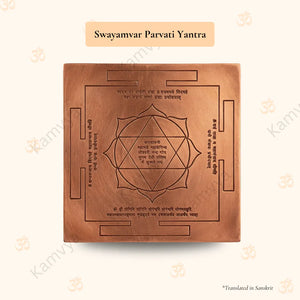
Swayamvar Parvati Yantra
A laser-engraved copper yantra rooted in Parvati Tantra, made for those preparing for marriage — designed to support Shukra (Venus) activation and strengthen the 7th house of partnership over a 41-day sadhana.
Explore the Yantra →